The Carolingian foundation of the Imperial Palace of Ingelheim was designed for representation and was nearly undefended. It was not until the Staufer period that, at the behest of Frederick I Barbarossa (1122−1190), it was converted into a fortified defensive structure. He had the palace renovated around 1160, enlarged its footprint, and established protective walls. This led to a profound change in the function of the Imperial Palace: it transformed from the representative palace of the Carolingians and Ottonians into a royal castle.
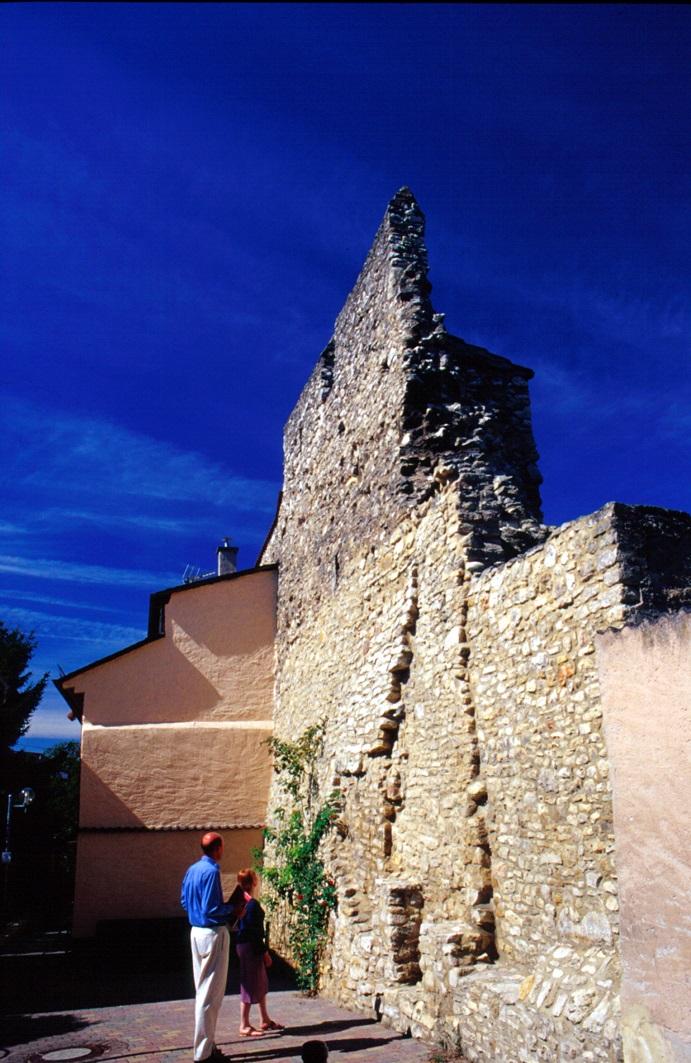
The fortification wall, still visible in many places around the Imperial Palace area today, was originally 270 m long and dates back to its oldest parts from the 12th century. It was continuously repaired, reinforced, and adapted to advancements in military technology until the 17th century. The walkway on top of the walls was probably covered and accessible via wooden walkways and stairs.
Many residential buildings in the palace area were built directly against the strong, stable fortification walls. This saved building materials, costs, and effort. At the same time, this practice contributed to preserving the fortification walls visibly at many points to this day. At the round trail station "Staufer Heating System" (Karolingerstraße No. 5), the fortification wall is accessible on foot and offers a panoramic view over the Imperial Palace area and the Rheingau.