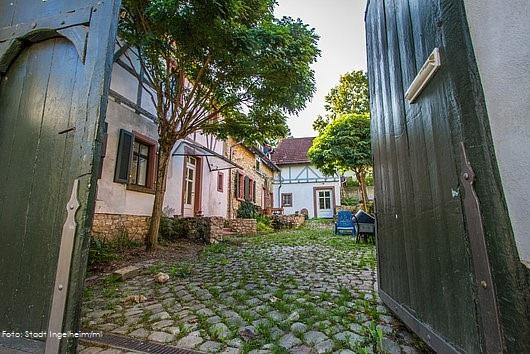
The building substance of the property largely dates back to the mid-19th century. Typical for the locality, the residential building features a solid masonry ground floor and a half-timbered upper floor. This house included six living spaces. The outbuildings were exclusively constructed from rubble stone. The courtyard is accessed through a gate structure with large wooden wings. The builder at that time was the municipal tax collector Nikolaus Kloos. In 1849, he succeeded the democratically minded mayor Johann Heinrich Klippel in office as the first. Between 1840 and 1860, he also appeared as the keeper of the community bull. A vaulted cattle barn with a cast-iron central column is still preserved. His son, the surveyor and farmer Jakob Kloos, served as mayor from 1876 to 1902.
By the way: The farming community with around 650 inhabitants had a considerable livestock population in the mid-19th century: 55 horses, 4 bulls, 40 oxen, 210 cows, 150 cattle, 142 pigs, and 10 goats.