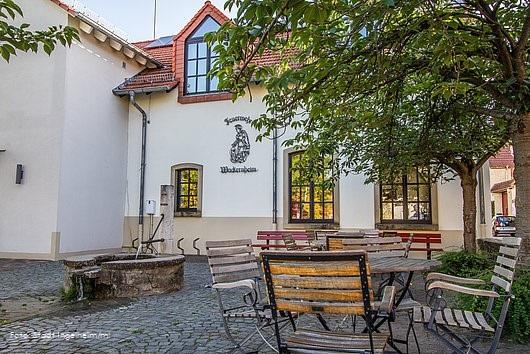
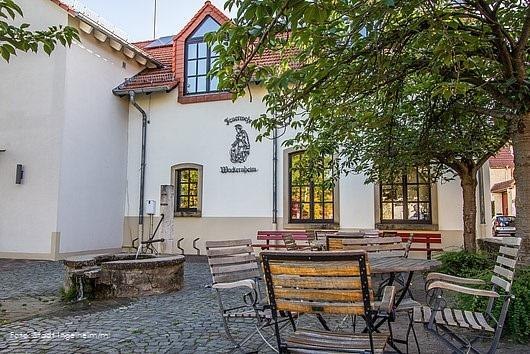
The former estate belonged to the family of Wackernheim's mayor Heinrich Klippel since the beginning of the 19th century. Through marriage, the property passed to Heinrich Krebs, who originated from the Heidesheim sand mill. In the 1860s, he housed and cared for the community bull. The keeping of the so-called "Faselochsen" (breeding bull) was clearly regulated and supervised by the district office in Bingen. The tenant had to purchase the bull at his own expense. The community paid a fixed annual amount for the maintenance of the animal. The lease was concluded for 5 years.
After the death of the heir Otto Krebs in 1892, the community acquired the estate and housed the school and the teacher's residence within it. In 1914, they built the bull stable for the community Faselochsen in a outbuilding. In the adjacent jumping hall, the cows and the bull were brought together. The vaulted stable, where pigs and billy goats were also kept, is now part of the village community house.
By the way: Mayor Heinrich Klippel was the highest-taxed citizen in Wackernheim in 1841. In 1867, the estate, with nine living quarters, was the best-equipped in the whole village. On the farm, three farmhands and two maids lived and worked in 1871.