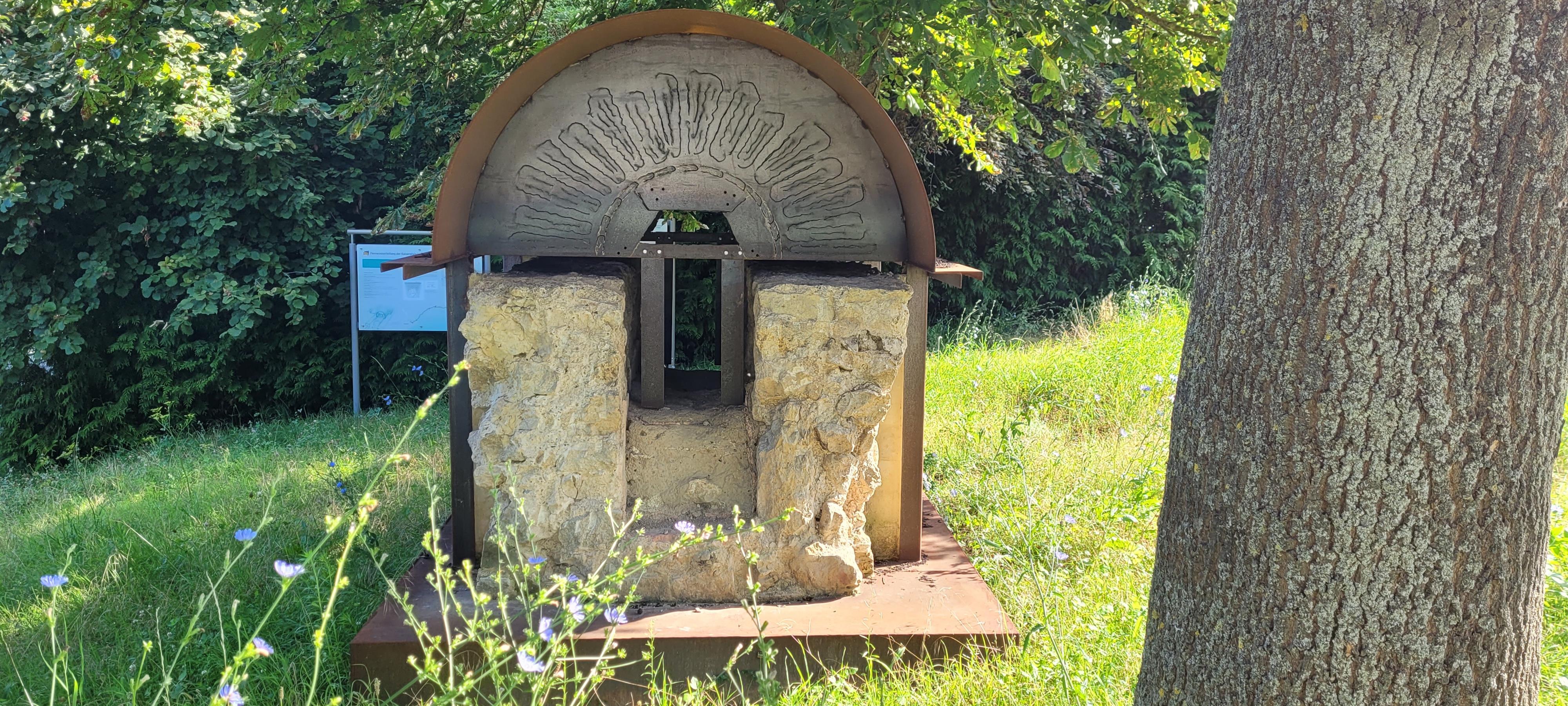
Here you see a section of an early medieval long-distance water pipeline. It was found in 2004 in close proximity. Scientifically, it has been dated to the construction period of the Imperial Palace, namely the late 8th century AD.
The long-distance water pipeline supplied high-quality drinking water from the spring area "Karlsquelle" near Heidesheim through the Wackernheimer Valley to Nieder-Ingelheim, into the palace of Charlemagne. This was achieved through a 6.8 km long canal, which mostly ran underground. The structure, built from limestone blocks, arched over a 40 cm wide trough, which was sealed with a waterproof special mortar (Opus signinum). It is easily recognizable on the bottom of the canal due to its reddish coloration. A section of this pipeline likely led directly to a settling basin in the center of the palace ("Basin of the Long-Distance Water Pipeline"), while another section ran in front of the outer facade of the semicircular building and could also be traced in the encircling round towers.
The construction followed the principles of Roman aqueducts. It holds central significance in the rediscovery of ancient building culture in the early Middle Ages and is so far unique for this period. Its construction was not necessary: there were sufficient water resources in the vicinity of the palace. However, it provided more high-quality and flowing drinking water. This allowed for the use of waterworks and wells, which could demonstrate wealth and luxury.
By the way: Just near the spring area of the long-distance water pipeline, remnants of a Roman water pipeline were found. It may have served as a direct model here.