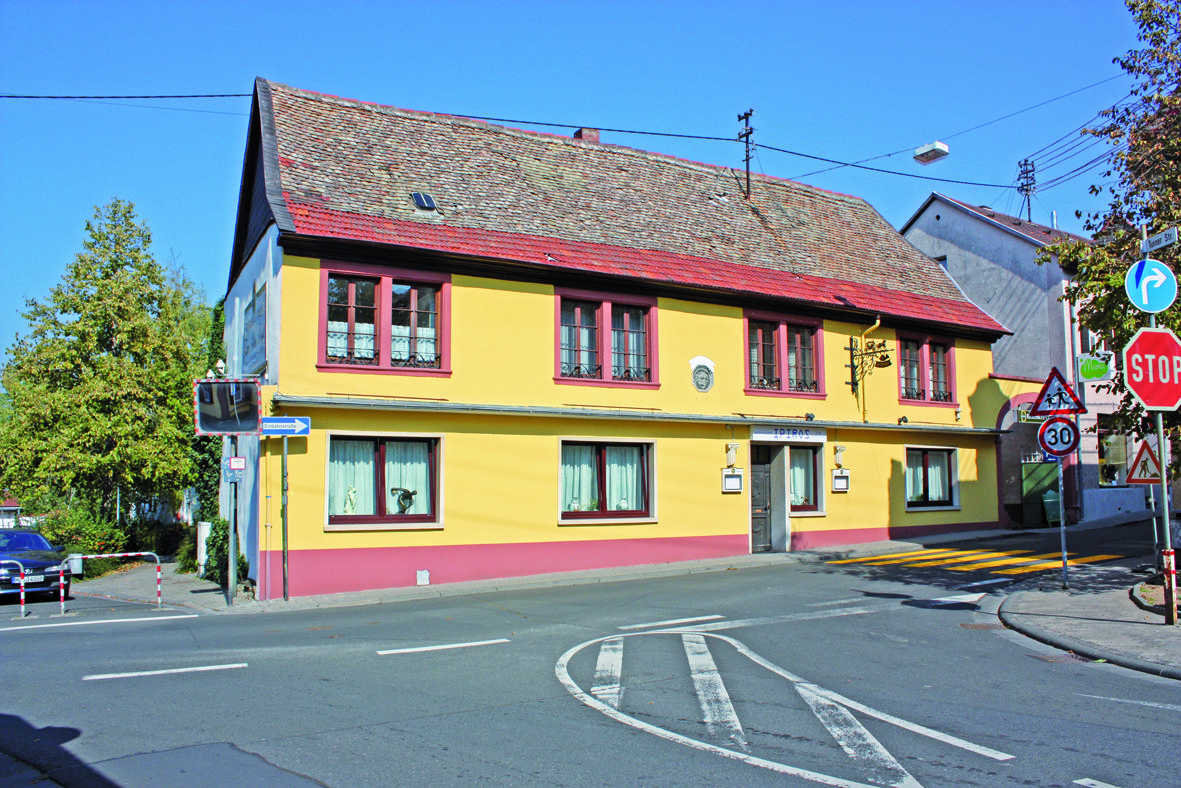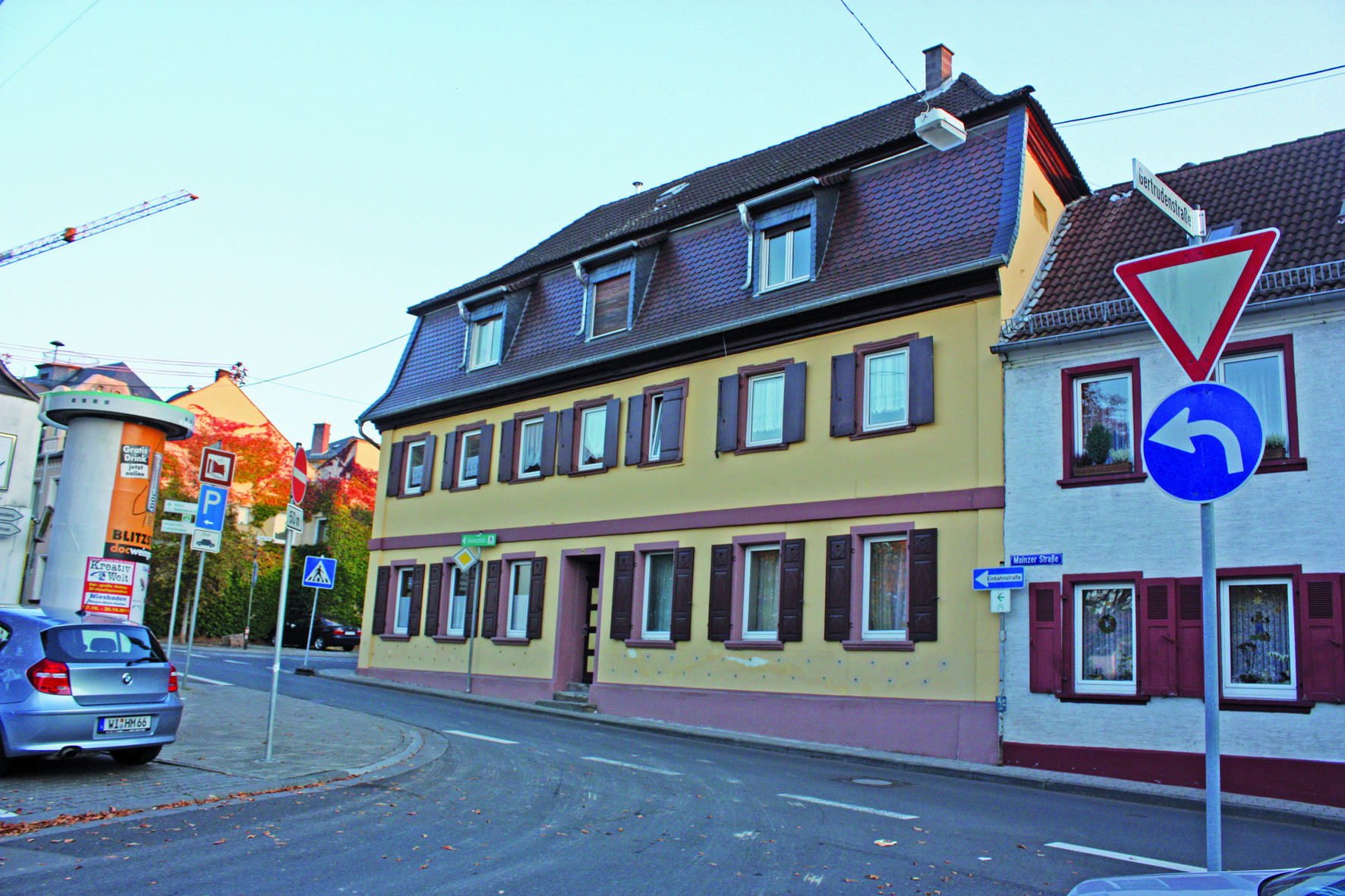
The former significance of Mainzer Straße as an important traffic connection is recalled by former post stations and stately former inns.
Former Inn "Zur Alten Post" (Mainzer Straße 67)
The now largely modernized Baroque building was erected in 1720. With rooms for travelers, shelter for horses and carriages, the property served as a post station until 1831. From 1704, the Palatine Post Coach route from Düsseldorf to Heidelberg passed through Nieder-Ingelheim three times a week. A mounted postman, who operated between Mainz and Bingen, transported letters and light packages.
Under French rule, the postmasters operated a private transport service. The intertwined initials LWG in the classicist doorplate recall the then-postmaster Ludwig Glöckle and his wife Wilhelmine. Above the door, the family coat of arms of the Lopes de Villanova, who were the tithe lords of Ober-Ingelheim, was incorporated. It depicts the tower of the Villanova house and two upright lions of Aptenzell. Originally, it was located on the grave monument of Amalia Dorothea Christina Lopes de Villanova, born von Aptenzell, which was destroyed by French revolutionaries in 1792/93.
After the death of her husband in 1813, Wilhelmine Glöckle continued the post station. When Goethe visited the Kaiserpfalz ruins in 1814, he stayed here and later mentioned in his account the landlady Mrs. Glöckle, with whom he had an animated conversation.
Former Inn "Zum goldenen Hirsch" (Mainzer Straße 60)
Diagonally opposite is a late Baroque, formerly three-winged property with a mansard roof from the 18th century, built on the site of a predecessor building mentioned as early as 1670. Until 1920, it housed the inn "Zum goldenen Hirsch". Afterwards, the cinema "Gloria" commenced operations here. In 1930, it was converted into a sound film theater. The cinema existed until the 1950s.